
You might be familiar with the seven wonders of the world, but what if I told you that you could taste them, right here in Kingston! I’ve chosen seven restaurants located in the Kingston Emporium, and I’m going to take you along with me this semester to understand the food, stories and people who are essential to these weeknight wonders. Each week, we’ll uncover the history and heritage of a restaurant; we’ll examine the ecosystem of chefs, cooks and servers behind each plate; and we’ll savor the flavors that provide the cultural nuance and meaning to a meal. Part food review, part restaurant profile, this series examines the relationship between community and cuisine on our campus. Hopefully, it also encourages you to use your palate as a culinary passport and experience more of the world. Let’s think beyond our borders. Welcome to “Weeknight Wonders.”
Fiery, biting, fragrant. One taste of papaya som tum at Simply Thai, and I’ve stepped into an alternate reality, a wonderland that upends my expectations of Thai food. Up is down. Left is right. The Thai flavors that once ensconced my palate have been uplifted by a rich culinary history deeply intertwined with Laos and its people.
Plated on a ceramic tile chipped on one corner, the julienned green papaya sits in a tapering shape. A handful of dry-roasted peanuts adorns the hydrated salad as the light and lemony cherry tomato bath with flicks of crimson pepper pools at the bottom. Tart and fresh, I’m captivated by how disarming it looks. Molten lava pours into my throat, claiming every cell of my body. I can’t resist. I have to go back for a second bite.
With ten years of successful ownership, Simply Thai puts it simply: the secret behind a great Thai restaurant isn’t a balanced red curry base or a tom kha that manages to warm the bottomless pit of your stomach. The best Thai food has to be made and served by Laotian cooks. Chef and owner Chanfong Louangxai’s life reflects this complexity and nuance.
Fong, as she’s known to friends and customers, left her home in Vientiane, the capital city of Laos, at 16 years old due to widespread political oppression and food shortages under the country’s communist regime. She spent the next six years of her life in refugee camps, confined for six months at a time in countries like Thailand and the Philippines before settling down in California during the late 80s.
Her journey into the food world occurred through happenstance. Following the births of her two children, Fong came to the state of hope in search of just that. She worked for a GMC plant, producing automotive parts for brands like Volkswagen until it closed in 1989. Her time at the factory was invaluable: she built a community of other Laotian immigrants in the New England area. There was a vested interest in seeing each other succeed: friends babysat for each other, took shifts at each other’s businesses and dropped off food when work ended late.
She had cooked for friends in the past, learning on her feet as she worked every job on the line at their restaurants. With the inevitable difficulties of a loose labor market, Fong turned to what she had the most experience in. She specialized in an industry that’s known for being anything but simple: restaurants.
There’s an ambrosial quality to the food Fong serves. It’s deeply Laotian, entirely driven by her tenacity and tasteful eye.
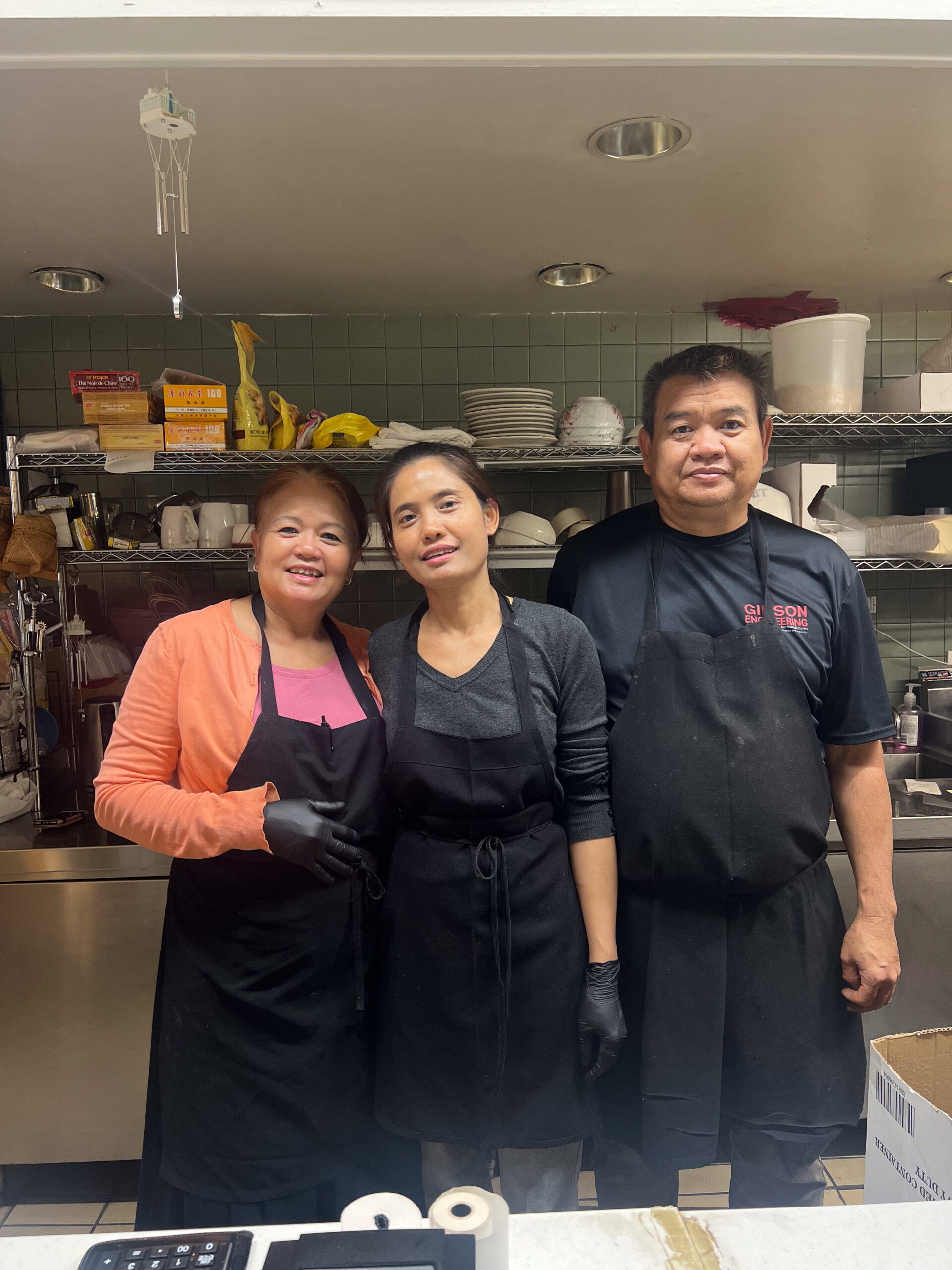
Even in the five minutes you spend waiting to pick up your order, you can hear the ingredients speaking a language that briefly interrupts the elongated tilt of Lao. Pop! Crack! Sizzle! It’s a harmony much like the one Fong possesses with her fellow cooks: Tu, her brother, and Mak, her sister-in-law. When asked why she chose to make this restaurant a family business, Fong had this to say.
“We love the Thai food,” Fong said. “We love Lao food. And we love to cook. It’s more easy to work with family. We understand each other, you know?”
Occasionally, Tu throws in a beat, ladling blanched vegetables into a wok, sweating a slate veil that hangs in the air like ribbon. Infused with aromatics, it only takes two of Tu’s sharp knocks before the wok skates over the flame, its vegetables trapped in a whirlpool of glazed mahogany sauce.
It doesn’t sit there for too long, though. Mak works their 12-hour shifts in a state of intense concentration. She invents new limbs as she fishes crab rangoons from the oil, wraps the fresh rolls in rice paper and transfers a bubbling coconut curry into translucent, ivory containers stuffed with broccoli, carrot and chicken. Tu’s stir-fry is next in line. Stacked into a paper bag with habitual ease, the dishes await the patient customer. The world melts away in their kitchen. Sizzles are synonymous with TV static. They work in symmetry.
Fong and I sit in one of the tan suede booths parallel to the spring green accent wall, sipping Jasmine tea in unison.
“Thai food,” Fong said. “They have little bit sweet and spicy, little bit sweet and sour, but Lao, it’s not that much sweet; it’s more taste. The papaya som tum, chicken barbecue and sticky rice, those are the signature from Laos.”
This time with Fong has inspired me to rediscover the culinary history and genealogy of dishes at other Thai restaurants. Observing with intention, I’ve earned the secrets the walls yearn to spill. Pieces of Fong’s heritage and identity are present everywhere. A set of two small frames catches my eye.
“That one’s really the culture,” Fong said. “They have sticky rice, the flute, everything from Laos.”
Gesturing to the reed fish traps braided in an ellipsoidal shape,
“The one above is to hold something inside,” Fong said. “That one is really important for the customer because it makes you more lucky.”
Examples like her growing collection of Southeast Asian ethnographic art truly make me feel like Lewis Carroll’s character. This is a wonderland, in its entirety. A wave of gratitude washes over me.
Looking closer, I see the restaurant not for what it is but for what it chooses not to be. Not simple. Not Thai. And certainly not dismissible. It’s Fong’s world, and we’re lucky enough to live in it. Four stars.
Simply Thai ☆ ☆ ☆ ☆
Atmosphere: A busy restaurant where locals, university students and passersby can order takeout and be seated, with accommodation for groups as big as 15 people. Wait time fluctuates based on the number of delivery orders.
Noise Level: At peak business hours, expect a range from hushed, whispered tones to normal speaking levels.
Tasted Dishes: Papaya Som Tum, Spring Rolls, Chicken Satay, Hot Basil Fried Rice, Spicy Eggplant, Pad See Ew, Mango Sticky Rice.
Price: $$ (roughly $20 per entree item)
Open: Monday to Sunday, 11 am to 9 pm.
Location: 99 Fortin Road #112, Kingston, RI 02881
What the Stars Mean: Ratings range from zero to five stars. Zero is poor. One star, fair or satisfactory. Two stars, good. Three stars, very good. Four stars, excellent. Five stars, extraordinary.