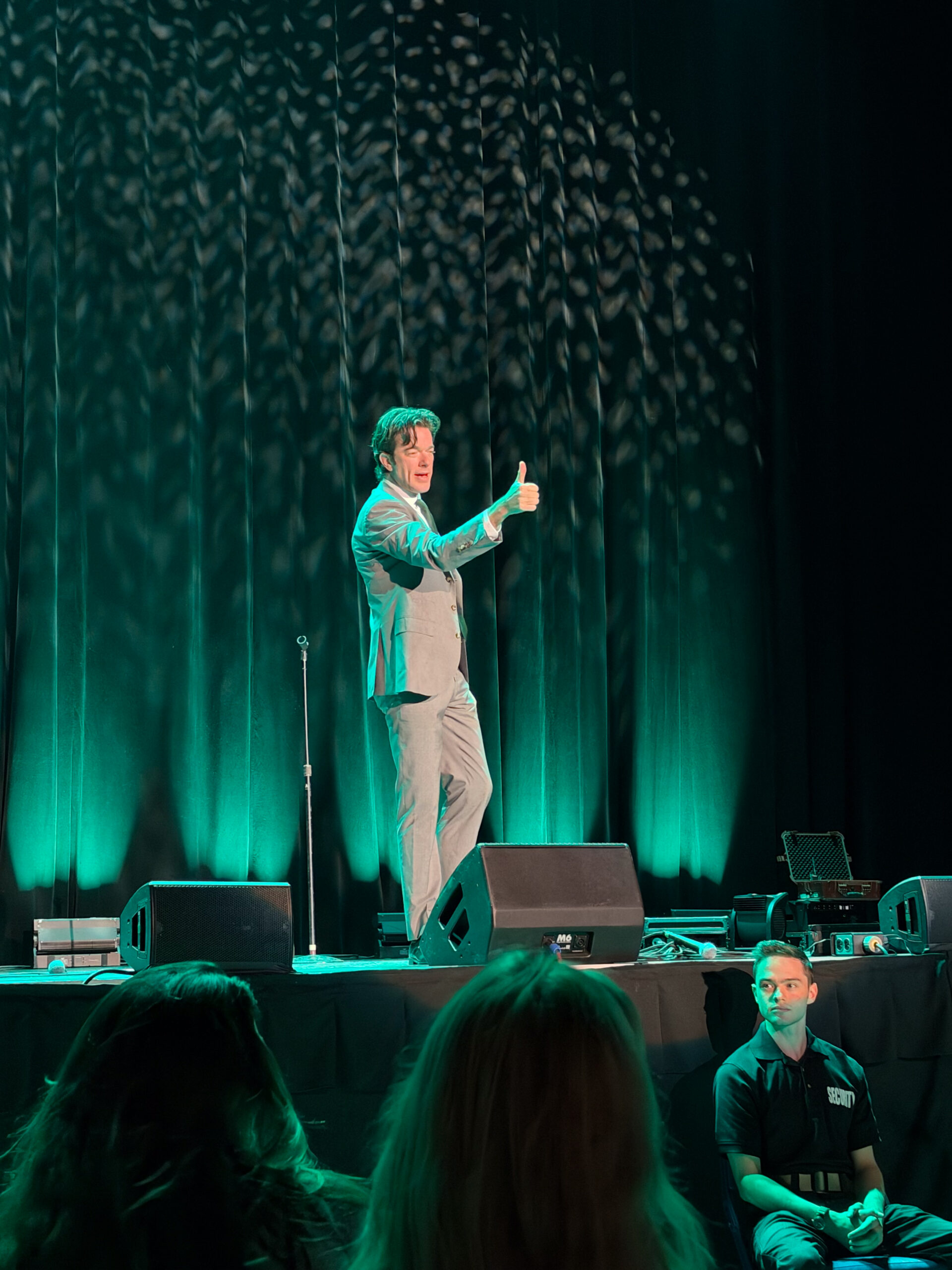
As rising comedians of the past 20 years go, it is hard to think of anyone with a more mind-boggling success story than John Mulaney. From Saturday Night Live writer to Primetime Emmy winner, Mulaney’s comedic mix of refined theatrics and bumbling anxiety has made him a cultural touchstone.
Thus, it came as a shock to me when I found out that he would be headlining URI’s annual Family Weekend at the Ryan Center. Nonetheless, I was elated with the opportunity to see someone who virtually molded a portion of my own personality at my own school.
I had high hopes for Mulaney’s show, and to put it bluntly, I was not disappointed. As a matter of fact, blunt is the word I would say best describes his performance.
As time has gone on, Mulaney’s comedy has shifted away from the high-energy antics of his youth to a grittier yet sharper tone. The former style mostly stemmed from Mulaney’s prior experience with drug abuse, something he has not shied away from poking fun at. Even at his show on Saturday, he remarked on a previous performance he had at the Ryan Center in 2019, which he did not remember but affirmed he was likely quite funny.
I personally don’t mind his brand shift, not only for his sobriety, but also for seeing his style evolve. Plus, I for one enjoy a comedian with some bite to their work, as long as they aren’t spiteful.
For example, a highlight of his show was an extended discussion about his group therapy experience, particularly with victims of patriarchal domestic violence. Mulaney proceeded to give an infomercial-esque advertisement where, for the low, low cost of $72 plus travel fees, he would beat the victims’ abusive father for them.
While jokes like these on the surface appear quite dark, Mulaney retains an underlying whimsy to what he says, which elevates his comedy beyond stark nihilism.
Similarly, at the top of the show he remarked how Providence is a city full of billboards for legal issues that only Rhode Islanders would have, and pro-life PSAs using ugly nepo-babies. As someone who can appreciate being the butt of a joke, both of these Rhode Island jabs had me cackling.
A personal highlight for me and the audience, however, was when Mulaney worked the front-row crowd. From a Marine Affairs student whose sister had the most successful gap year ever as a farmer, to a relative of two students who had better plans playing League of Legends, Mulaney stumbled into the full range of the URI experience in a way one could not script if they tried.
I, for one, belted out a resounding “EWW” when he mentioned the latter video game, to which Mulaney remarked that I, among many others in the third level, cried out like he had walked a wounded animal on stage.
One point of contention I do have is with Mulaney’s final story of the night revolving around the extended family of his wife, Olivia Munn. Specifically, he discussed some of his escapades with her baker’s dozen of Vietnamese immigrant relatives, including impressions and pseudo-stereotypical experiences he’s had with them.
Now, I will note that Mulaney prefaced this by acknowledging the surface-level poor taste of it and providing a lengthy backstory of his wife’s family history. This added context helped the bit make actual sense and not come off cruel. However, as an American white guy, the determination of severity for these jokes is not my place to speak.
Another sticking point I noticed was with the show’s opener, Andrea Jin. While I did find her performance funny — especially her jokes about attachment styles — her segment felt monotone and strung together. Granted, I am not familiar with Jin’s prior work. Like most openers, she likely flourishes in her own setting.
Overall, I would certainly say Mulaney’s show was more than worthwhile. It definitely sits alongside his prior special, “Baby J,” as a comedically dry, yet unforgettable performance. I’d be lying if I said I wasn’t dying laughing the whole time, and if anything, my biggest complaint was that I couldn’t buy a recording to commemorate the event.