
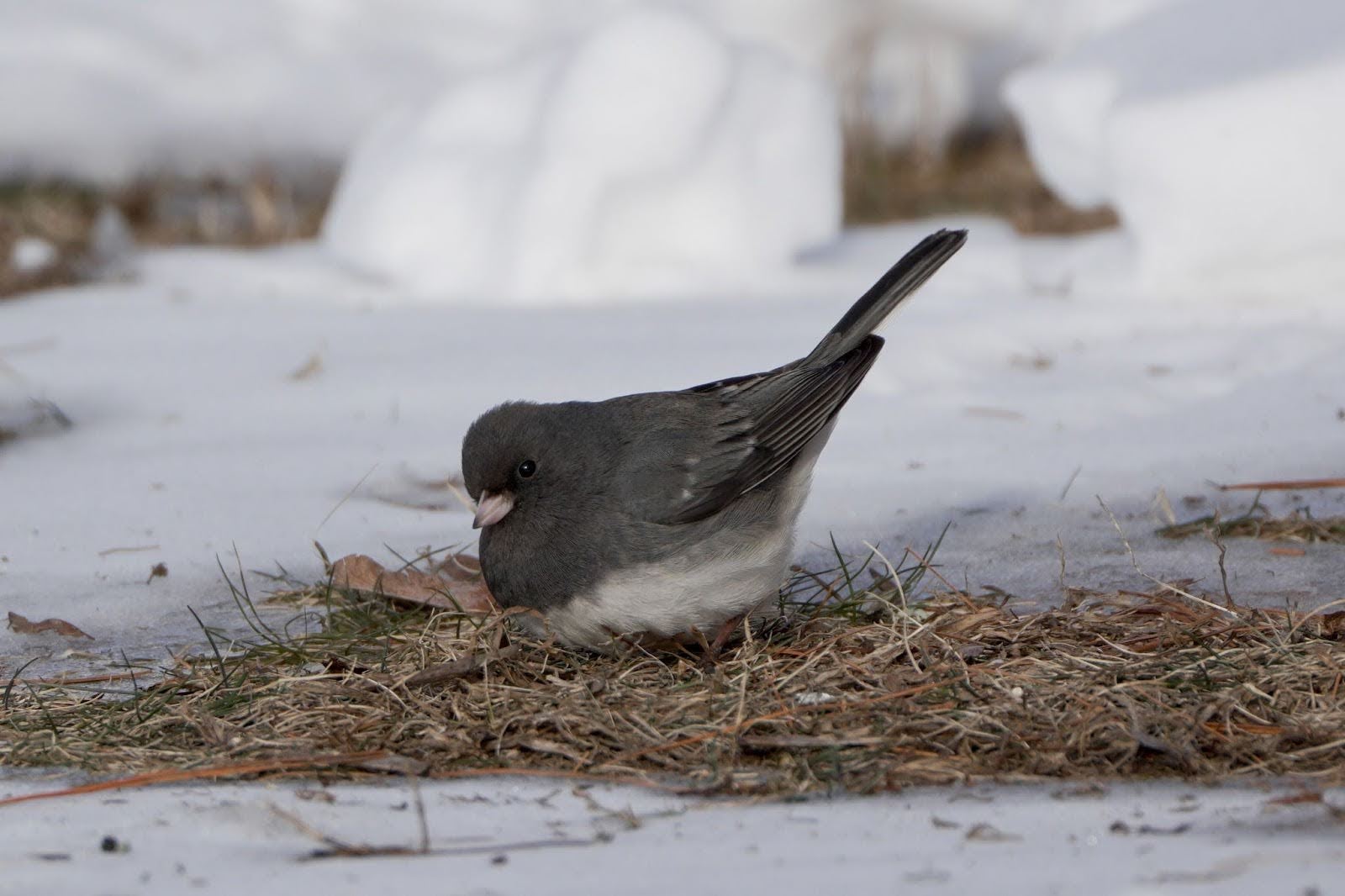
Junco hyemalis–the dark-eyed junco–is a small snowbird common in most of North America and is quite abundant on campus during this time of year.
Dark-eyed juncos feast primarily on seeds but will also target insects when the opportunity presents itself.
The dark-eyed junco’s ecology is a “what you see is what you get” situation. They sing, they fly, they flock; they do everything you would want a snowbird to do. However, they have some quirks that make this otherwise ordinary species special.
Juncos go from a relatively solitary life to a social flock in the winter, the inverse of the norm in the bird world. That is when these birds truly live up to their colloquial potential.
During this time, you can see these remarkably small birds galavanting around our snow-covered campus. They don’t peacock around; for them, an audience isn’t necessary. The only things that matter to them are finding good company, discovering tasty seeds and making the most of the season.
Dark-eyed juncos also have a variety of different patterns and colors, largely based on sex and geographic location. This makes them just a bit more flamboyant and fun than the common drab colors you see in snowbirds.
Likely long before modern genetically differentiated humans and nearly confirmed to be present way before the advent of civilization, we have assigned meanings and metaphors to animals.
Foxes are sly and crafty, snakes are untrustworthy, groundhogs have a cruel mastery of time itself, and so on, across cultures, and through the ages.
Perhaps my initial hesitancy about the personification of animals leaves out the whole picture. Although distinction is important, the more we investigate animals, the more complicated their behavior and cognition appear. Sometimes we really can ascribe personality traits to taxa. Sometimes behavior is hardwired in their biology. There is a reason why most dogs are loyal beyond a doubt, and why we all loathe mosquitoes. Even with my relative acceptance of this, can an animal really symbolize hope?
Hope is dirtier than you think. As much as it is romanticized, it comes from something unsightly. In order to wish and believe in a better future or for a future that is just good enough, one has to come to the chilling realization that it just might not work out. Hope is meaningless if there is an obvious answer to a path or if achievement is guaranteed. Hope is perseverance in the face of many outcomes of varying success. Hope seems to be human.
To many, the dark-eyed junco represents hope. Something that I find more elusive the more I realize just how many paths life may take me. Although the connection eludes me, who am I to deny that every looming need for perseverance, the foundation of anything that is truly earned and built.
If you choose to see symbols and emotions in nature, the next time you see a dark-eyed junco, peacefully living, allow yourself to accept and work towards a soon that is better than the now.