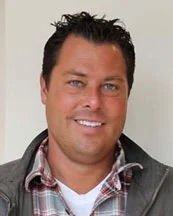
From singing in a band to traveling the world, Spanish Professor William Stark’s career has been full of many twists and turns.
Stark grew up in Eugene, Oregon, and began his education at the University of Oregon in 1980, where he studied a variety of languages, including Latin, Greek, Spanish, French and Italian. Three years later, he attended school in California and the Cornish College of the Arts in Seattle, focusing mostly on his art career.
In the 1990s, Stark spent time in a self-formed rock and roll band called Nowhere Garden, where he was a singer, lead guitarist and songwriter. The band performed regularly and was well known in the area, according to Stark.
“The thing I love to tell people is that we recorded in the same studio as Kurt Cobain and Nirvana in Seattle, which was cool,” Stark said.
In 1998, Stark decided to try his hand in the restaurant business and began working at Salvation Cafe in Newport as a chef until 2001. He was then presented with the opportunity to travel to Ireland where he fell in love with the Bulman Restaurant and Bar in Summercove and ended up working there for about a year.
Stark then travelled to South America, where he rented Casa Hood, a restaurant nestled in the foothills of the Andes, in Baños de Agua Santa, Tungurahua, Ecuador.
“That’s [Casa Hood] where my Spanish came in,” Stark said. “Speaking Spanish every day in a work situation prompted me to go into Spanish later on.”
Stark rented Casa Hood in Ecuador for about a year before returning to Newport to become co-owner of Salvation Cafe from 2005 to 2008. Upon returning to Newport, he met his wife, who was working as the dean of an online university. His partner at Salvation Cafe, Sue Lamond, bought him out in 2007, and the restaurant closed shortly after COVID.
Deciding to further his education once again, Stark finished his studies at Western Washington University with a BA in French in 2009. After watching his wife’s work, Stark said he gained a greater appreciation for academics. Stark pursued his Master’s Degree in Spanish at the University of Rhode Island in 2011 and earned his doctorate at the University of Connecticut in 2018.
In 2018, Stark began working at URI as a short-term substitute professor, where he taught Colonial Spanish American Literature in a graduate class while also teaching at Brown University. In 2019, Stark was offered a full-time faculty position at URI.
“The lifestyle of a professor wasn’t 24/7,” Stark said. “As an owner of a restaurant, there’s no rest whatsoever. I’d spent most of my life in kitchens and restaurants supporting my education, music and painting, so that was a huge step in a different direction.”
Stark is working on a book, “Artificial Savages in Transcultural Landscape,” that is scheduled for release in 2026. The book focuses on the United States-Mexico border and looks at a handful of performance artists in the U.S. and Mexico who have been involved in border politics, border art and border theory since the 1980s.
“They [the performance artists] saw the future because what’s happening now is very much what they were saying in the 1980s,” Stark said. “The book looks at what’s happening at the border now through the eyes of those who saw similar things happening in the ‘80s.”
In addition to teaching, Stark contributes artistic works to the Newport Art Museum at events, including the “Wet Paint” fundraiser.
Stark’s work has been featured at galleries in Ireland, Ecuador and Seattle. He also contributes to the community in musical ways by participating in open mic nights around Newport.
Currently, Stark is an associate teaching professor and the Spanish section head. This semester, he is teaching SPA 210: Spanish for Heritage Speakers and SPA: 305 Early Spanish-American Literature and Culture.
“Being a professor really puts me in touch with my past in a way that no other career could,” Stark said. “As a professor, I have a sense that I’m helping students out in deciding what they’re gonna do with their future, and that’s the part I like most.”
Stark hopes that in the next few years, he will be able to give back and guide more students at the university. His main goal now is to bring language back as a general education requirement for all undergraduate students. His contributions to the URI community go as far as his involvement in the Faculty Senate, the Gen-Ed Committee and the College of Arts and Sciences Assessment Committee.
When not at URI, Stark spends time sailing, writing, biking and with his family.
Students interested in becoming more involved in the Spanish department, can keep their eyes open for the Latinx/Hispanic Heritage Month celebrations that the Spanish program hosts in collaboration with professors across disciplines from Sept. 15 through Oct. 16.