
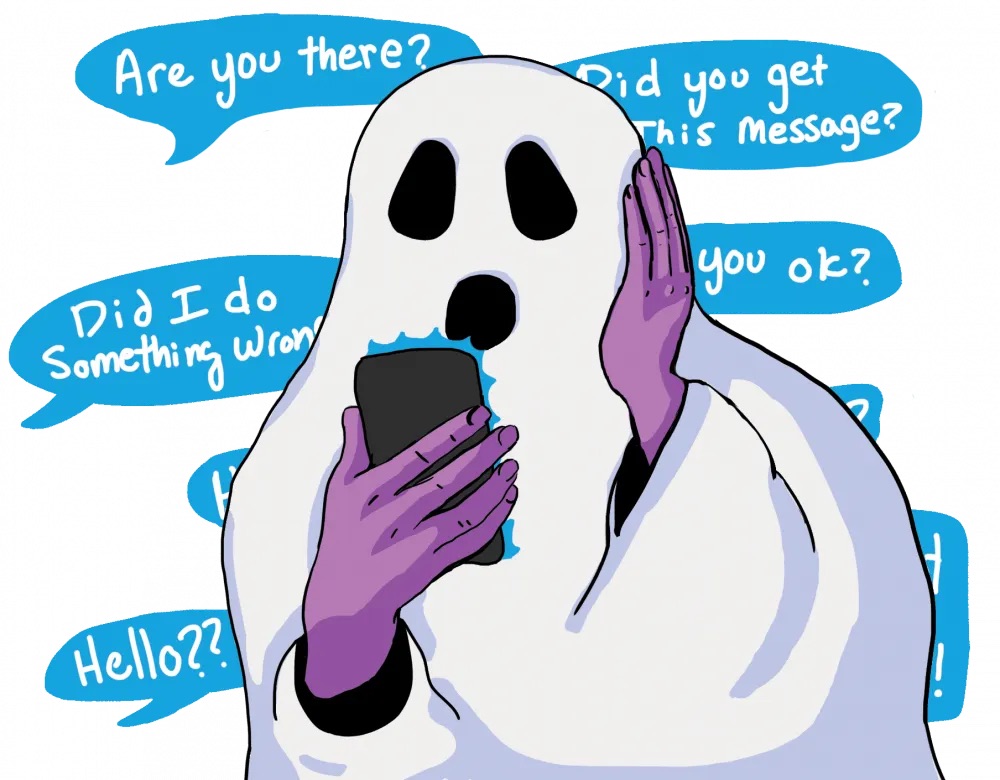
There is a chill in the air this time of year, a kind of eerie feeling that covers itself over campus like fog. The days get shorter and the nights stretch longer. Everything feels more electric. Maybe it’s the way the air turns crisp, or how the moon lingers just a little too long.
Watching, waiting, glowing over late-night confessions and unanswered texts.
This is the season of ghosts. But not the kind that haunts abandoned houses. The ones that linger quietly in our lives — in the silence after a message left unreturned, in the memory of a touch that once felt comforting, in the name that still makes your heart skip a beat when you hear it after months of nothing.
Ghosting. The modern haunting.
It’s the phenomenon of vanishing, not into thin air, but into indifference. One moment, connection sparks like lightning; the next, it’s static. No explanation or closure, just absence and a sudden gaping space where something once was.
We like to call it normal, but there’s nothing normal about being erased. There is a particular ache that you get when realizing someone you trusted with unseen versions of yourself has quietly decided you’re no longer worth a text. It feels less like an ending and more like you’re trapped in a state of endless in-between. You can’t face yourself to move forward because you never got to say goodbye.
And yet, somehow, we’ve normalized it. We laugh about being “ghosted” as if it’s just another part of dating. But the truth is, ghosting leaves its mark. It makes us question our worth, our intuition and our ability to read red flags. It makes us suspicious of everything that comes after. We are hesitant to believe in connection again.
The irony is, most of us have been the haunter at one point. We’ve vanished from someone’s life when the spark dimmed because it felt easier to quietly disappear than to explain. Maybe that’s why ghosting feels so universal, it’s the modern language of avoidance; the love story that ends with a fade to nothing.
But what if ghosting isn’t just just about fear of confrontation? What if it’s about our collective fear of intimate connection? To ghost is to back out before being seen too deeply. It’s a cowardly way of controlling vulnerability. Because once you’ve truly been seen, with all the flaws and fears, you can’t disappear without consequence.
And maybe that’s why ghosting hurts so much. It’s not just the loss of a person, it’s the constant denial that what you shared ever existed.
Still, like all hauntings, the ghosts we encounter serve a purpose. They remind us of the boundaries we never set, our patterns and the longing for something real. They force us to find closure with ourselves instead of waiting for someone else to grant it.
Eventually, we learn: the only way to stop being haunted is to stop opening the door to those who vanish when the light comes on.
As autumn deepens, I find myself thinking that love is never really about permanence but about presence. It’s about who shows up and not who disappears.
So maybe this Halloween season, instead of fearing ghosts, we learn to honor them. We acknowledge what they taught us, we light a candle for what’s gone and we move forward.
We end up wiser and unafraid.
Because love, at its core, has always been a little supernatural. A strange force that defies logic and time. And no matter how many hauntings we survive, we still open the door, again and again hoping that maybe this time, the one who knocks will stay.
Because in the end, the only thing scarier than being ghosted is never daring to be haunted at all.