
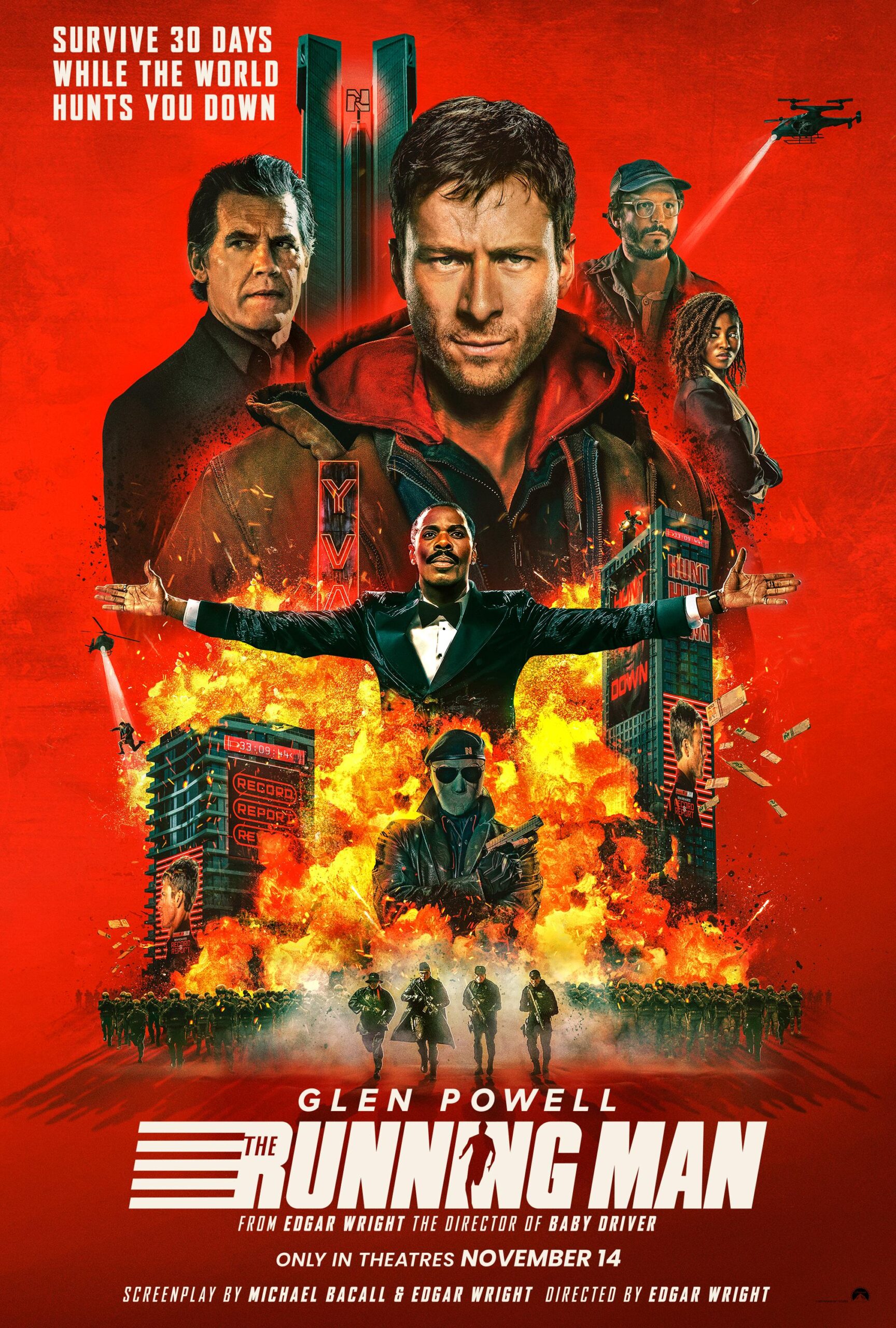
Stephen King’s “The Running Man” has its second movie adaptation in theaters now, 38 years after the original, directed by Edgar Wright and starring Glen Powell.
Stepping out of the theater, the first thing that came to mind was that this film felt like all four “Hunger Games” films combined with all four “John Wick” films.
Unsurprisingly, this is the latest project of Powell’s that continues to endorse him as Hollywood’s next Tom Cruise action-type star.
Naturally, I must compare Powell’s portrayal of the main character, Ben Richards, to the 1987 version with Arnold Schwarzenegger.
Simply put, Schwarzenegger brings more of the raw anger that Richards is supposed to carry with him throughout the movie. Powell is giving his all here, but he still radiates too much golden retriever energy for my liking.
I can’t complain anymore about Powell, or the rest of the cast for that matter, as they are what carry this plot through a wickedly fast pace in the 133-minute run time.
The beginning of the film breaks down the predicament that Richards finds himself in, which is that his infant daughter, Cathy, is sick and will die if she doesn’t get treatment soon. This takes place during an undisclosed time in the future of the United States, and the Richards family is one of many living in poverty, so they cannot afford the treatment for Cathy.
After being blacklisted from his blue-collar job for union activism, Richards, despite protests from his wife Sheila, ventures to the Network, an authoritarian media ruler, in hopes of bringing home money. He is selected for the most popular show on the Network, The Running Man.
The premise is simple: survive 30 days while being hunted by civilians and hunters to win $1 billion. Despite notoriously never having a winning runner on the show, Richards agrees to the show when executive producer Dan Killian, played by Josh Brolin, offers him an advance for Cathy’s medication and a safe house for his family.
Intermittently, the host of The Running Man, Bobby Thompson, played by Colman Domingo, pops up to provide context on the progress Richards has made.
Unlike the 1987 version, the other two runners Richards is paired with have no plot value other than being used in a quick explanation from Daniel Ezra’s character about how the game works.
Richards is the sole contestant within just a few days of the game, as he bounces from city to city, avoiding death at all turns.
The best way to describe how Richards escapes from the hunters and civilians is cartoonish, especially with the grenade sequence that is highlighted in the trailer.
The side characters in this film also have as much depth as a cartoon character. Even Michael Cera’s character, Elton, is not given much to work with. The only good thing to come out of this is that Brolin is given more screen time and is exceptional in the final act, upping the intensity of the film.
One of my biggest gripes with the film is how it handles the Network’s propaganda through deepfakes. This is a key part of both this film and the 1987 film, as it’s made clear early on that the Network can seamlessly edit footage to warp the audience’s minds and make them believe anything.
This is not a problem until the film tries to make us believe that Richard’s family is dead. Killian shows footage of the hunters tracking down Richards’ family in the safehouse and killing them, and this is met by immediate outrage and no disbelief.
After Richards has seen firsthand that the Network constantly deepfakes videos, he doesn’t have one thought that they may have edited the footage of his family dying?
This is followed by a twist I actually liked, which was that the main hunter, Evan McCone, was a runner who appeared in the show’s first season and supposedly made it to 29 days. However, there isn’t much done with this character besides further exposing the secrets of the show, and Richards kills him.
The ending of this film comes after Richards seemingly dies in a plane crash, and the uncensored recordings of the Network are exposed, creating a roar of outrage by the public against the Network.
In the following season of The Running Man, this anger comes to a boiling point, as the public attacks the sound stage. For the final shot, Richards emerges from the crowd, shooting Killian.
All in all, the absurdity of this film does make up a good chunk of its charm, but I cannot overlook the plot additions that clutter it up and end up weighing it down. In half an hour less run time, the 1987 version manages to get the point across in a tighter and more simplified way. Both films can be a fun time, but I’d go with sitting through the 80s camp if I had to decide between the two.