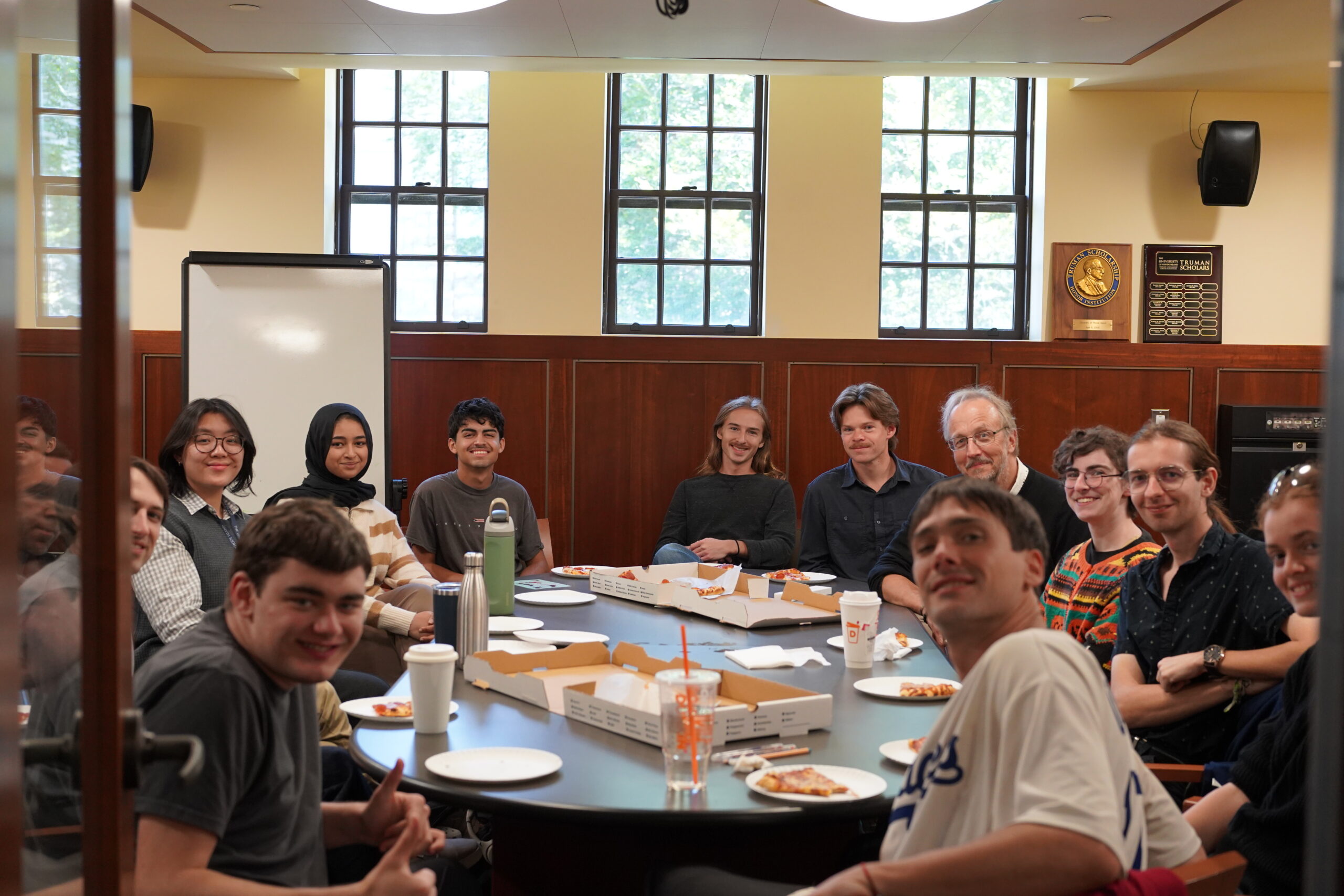
The University of Rhode Island Honors College led a conversation over pizza about tradition, gender roles and community on Feb. 4.
The discussion was led by moderator Karl Aspelund, associate director of the URI honors program. Aspelund challenged participants to consider how tradition shapes everyday behavior at both the personal and societal levels.
Aspelund opened by framing tradition as both a potential constraint and a necessary structure, stating that in an unfamiliar world, people would navigate basic social interactions without inherited customs.
“Imagine if you were in a totally radically new place,” Aspelund said. “Without shared norms, you wouldn’t even know how to greet someone.”
Students responded to Aspelund’s prompts by offering examples of traditions they participate in and how breaking them can serve as a form of protest.
One student referred to standing for the national anthem as a familiar social ritual, noting refusing to stand can signal opposition to government actions. Others described school-based protests, including challenges to dress codes, which students argued often regulate girls more harshly than boys.
“In many cultures women are treated as standard bearers for community ideals,” Aspelund said. “Particularly through appearance, making them frequent targets of enforcement.”
Some students spoke about the social consequences of breaking norms, describing tradition as reinforced through social pushback. Others countered that acceptance can depend on context and presentation.
“People can respond differently when someone simply shows up and exists without framing their choices as a confrontation,” One student said.
Students broadened the topic beyond gender to regional and cultural differences in how strictly norms are enforced. Several described how they believe expectations can vary widely.
“Some traditions began for practical reasons such as hygiene or safety, and can be difficult to evaluate fairly once their original purpose,” One student said.
Students shared personal examples of traditions which they viewed as protective.
“In my culture, we have a concept called mehr, which is a dowry intended to give women resources if a marriage becomes unsafe,” One student said.
Another student highlighted hospitality norms in foreign countries where neighbors may freely enter one another’s homes, share food or offer help. These practices were contrasted with what they described as a more guarded isolated social culture in the United States.
Some participants connected the difference to modern life in America, pointing to the linger effects of the COVID-19 pandemic on local community ties.
“Traditions only continue when people make a deliberate effort to keep them alive,” One student said.
Aspelund thanked student participants and encouraged them to continue these conversations across campus.