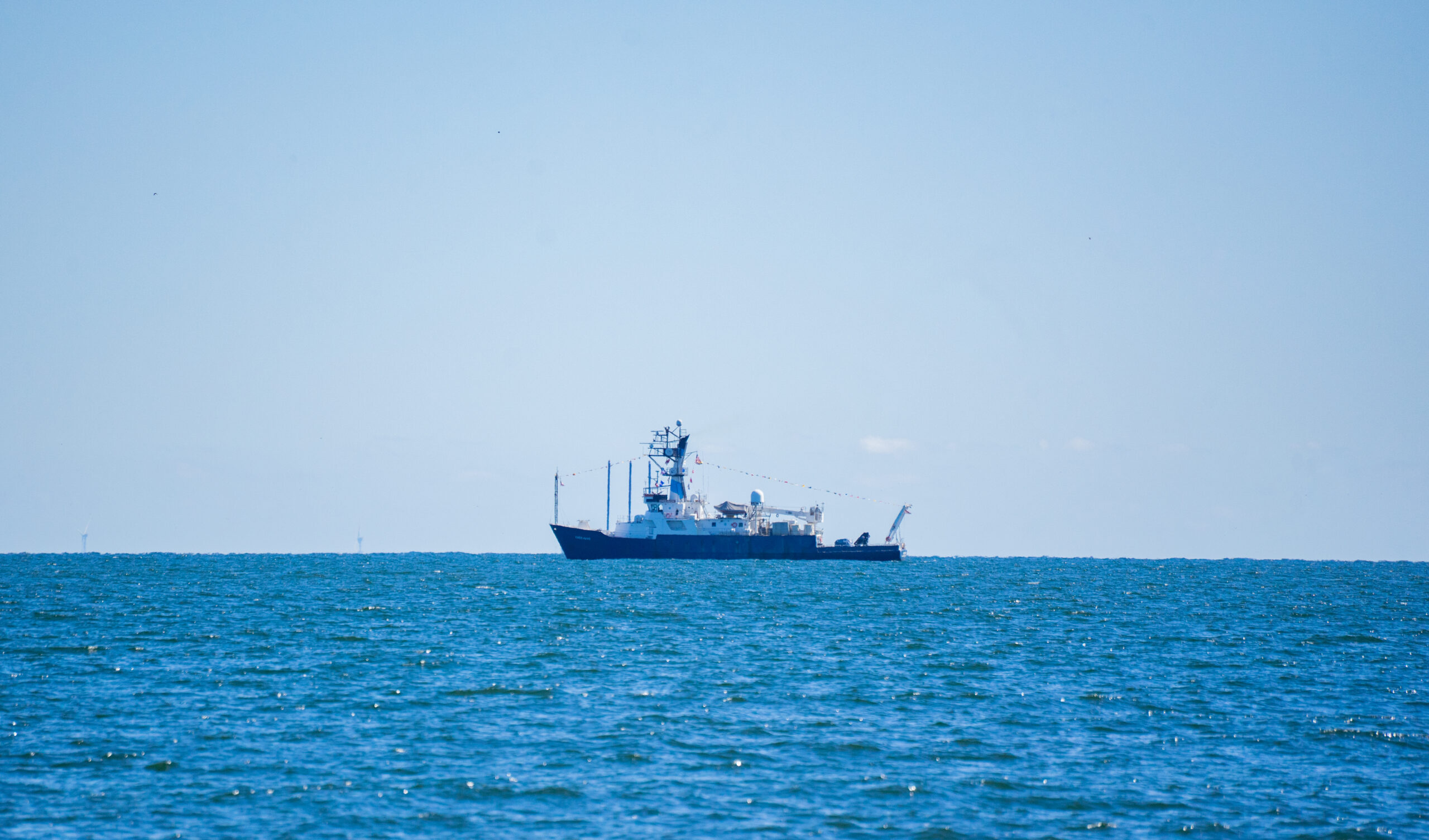
The University of Rhode Island’s research vessel Endeavor has officially retired after serving the Graduate School of Oceanography for 50 years.
Endeavor came back to the GSO’s dock from its last voyage in Canada on Saturday, according to Erich Gruebel, the manager of marine scientific research at the GSO. On the voyage, GSO’s marine scientists worked with the Canadian government to look at the long term effects of undersea oil drilling wells.
Endeavor completed 763 cruises, according to Gruebel. Over that time period, 96,000 scientists traveled with her for research. Most of the cruises were funded through the National Science Foundation and the Office of Naval Research.
“My favorite [cruise] was mapping methane in the Atlantic shelf back in May, which lasted around two and half weeks,” Gruebel said.
The GSO received Endeavor in 1975 from the NSF, according to Grubel. It was the second of three research vessels built at the NSF. The other two were RV Oceanus, which went to Woods Hole Oceanographic, in Wood Hole, Massachusetts and RV Wecoma, which went to the University of Oregon.
Wecoma retired in 2011, according to Robert Campbell, an associate marine research scientist at the GSO. Oceanus went to Oregon State in 2012 and retired in 2021, so Endeavor lasted the longest out of the three NSF ships.
Endeavor was well designed for working in the Northwest, according to Campbell. Researchers were able to use a wide variety of net systems, tow vehicles, conductivity temperature and depth sensors and water collection devices. Incubation experiments were performed on deck using reserved sea water. Other experiments performed involved water collection and net samples from stove plankton.
Some research was conducted in Endeavor’s wet laboratory, according to RV Endeavor’s website. Most of the research involved collecting seawater and mud samples from the ocean floor. The lab is constructed with plywood sheets so scientists can perform experiments with expensive equipment even in harsh conditions.
Some of the cruises, such as the RI Teachers-at-Sea program, required teams of graduate students, physical, biological and chemical oceanographers, technicians and a chief scientist to oversee projects, according to Campbell. These projects were funded through research grants from the NSF.
“My fondest memories on the Endeavor are working on the United States blowback program, which involved global aviation ecosystems, spanning from 1994-1999,” Campbell said.
Every five years, Endeavor goes onto GSO’s dry dock for inspections and repairs, according to Gruebel. After inspections and repairs, it goes to the shipyard to prepare for the next voyage. Within her 50 years of service, all inspections and repairs were minor.
Endeavor will officially leave in April of 2026 to a scrapyard in Brownsville, Texas, according to Gruebel. The general public ask if it can be repurposed or refitted as another research vessel for another institution. The short answer is no because the ship has lived its maximum life.
“It’s nice knowing [Endeavor] has lived its entire 50 years doing research cruise, which is exactly what you can expect,” Gruebel said.
In the meantime, the GSO is removing scientific equipment and computers to be repurposed for Narragansett Dawn and two research vessels, Taani and Gilbert R. Mason, constructed by the Oregon State University, according to Gruebel. Narragansett Dawn is set to come to the GSO by the spring of 2027. When it arrives, cruises will begin in February 2027.
Narragansett Dawn is operated by the East Coast Oceanography Consortium, according to Gruebel. The GSO will lead research collaborations with Woods Hole Oceanographic in Massachusetts and the University of New Hampshire. Each cruise will involve 11 associate members to create research, educational and outreach opportunities in ocean science and exploration.
To visit the Endeavor before it leaves, there will be an open house to the public on Oct. 4 and 5, according to Gruebel.