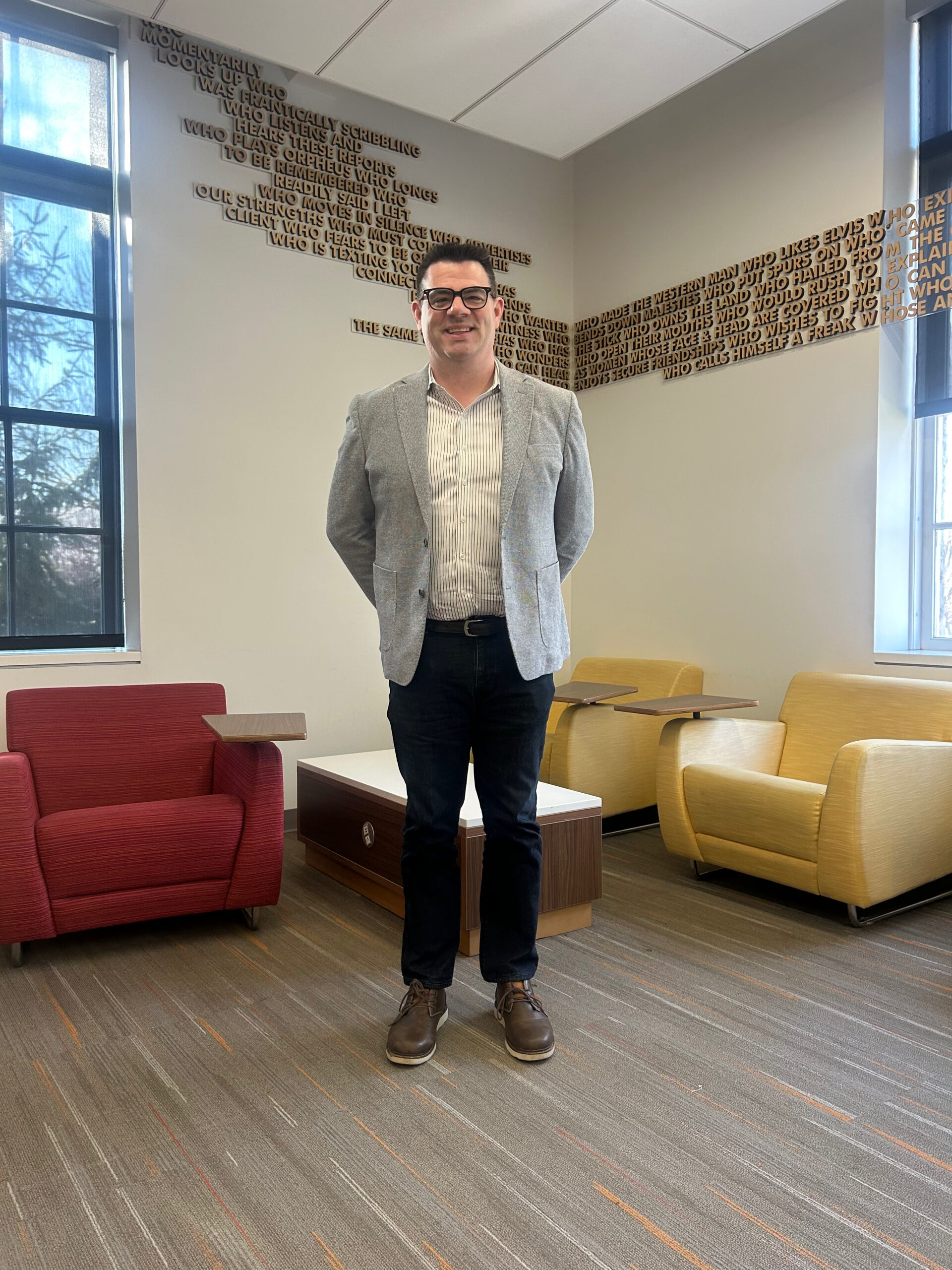
John Brickley, a former host on ESPN and producer for CBS Sports, spoke of the steps necessary to hone your skills and work as a broadcaster in such a competitive industry.
“I always say ‘learn everything,’” Brickley said. “Learn how to direct, learn how to run a camera, produce and do on-air because you’re going to get more opportunities because of it.”
Brickley, a Seton Hall University graduate and a part-time professor at Quinnipiac University, talked about his journey, and part of what he shared is how he became a great sportscaster.
“Don’t just focus on being on air,” Brickley said. “Be on the air and behind the scenes, because the best play-by-play announcers and the best studio people have a great relationship with the people who work behind the scenes.”
After going to school and interning at Channel 3 in his senior year of college, Brickley made the jump to his first TV job outside of school.
“I got my first TV job in Ephrata, Pa.,” Brickley said. “I had no idea where this place was, but I was doing my own shooting, I ran the show and they had remote play-by-play games I did on the side, like lacrosse and softball.”
Fortunately for Brickley, he found his calling on ESPN and showed why connections are so important in this industry.
“I was in a bar with a buddy, and the guy next to me turned out to be Marc Kestecher, who does the NBA Finals for ESPN Radio,” Brickley said. “They brought me in for an audition for radio, but then a position for a studio host opened up, and I just went after that.”
Brickley touched on one of the classes he teaches and how valuable it is for students to learn important skills when working in sports to be able to set themselves up for the future.
“In my reporting class, you have about two and a half hours to put a rundown together,” said Brickley. You go out, shoot a couple games, come back, edit them, put up graphics and then go on air in three hours.”
Brickley mentioned how fortunate the sports media group is at URI, having the opportunity to broadcast, write and go to press conferences at the Division I college level.
“You’ve got to treat this now like a full-time job,” Brickley said. “Once you graduate, to get back to that Division I level is hard.”
There are many different aspects of being a broadcaster, and Brickley talked about how you have to be able to know the difference when it comes to broadcasting on the radio compared to on TV.
“You can’t treat playing a game on radio like doing a game on TV,” Brickley said. “Less is so much more on TV, and if you listened to the last two minutes of the Duke [University] vs [University of Connecticut] game, Ian Eagle barely said a word until he actually had to.”
Brickley talked about a keyword he uses when doing broadcasts and listening to them so that a pivotal moment in a game or match isn’t messed up.
“Let it breathe,” Brickley said. “In those big moments you don’t have to say anything, and as broadcasters we think we fill the dead air if somebody’s not saying anything.”
The landscape of working in sports media is ever-growing and has changed drastically over time, giving the new generation many different new ways that they can create media.
“The difference between me going to college in 2006 and you guys going to college in 2026 is that you can go home and put a podcast together and send it in over on social media,” Brickley said. “When I was in college, you couldn’t do that, and we didn’t have resources like ESPN+.”
Brickley’s message showed how important it is to try a little bit of everything if you want to work in the sports industry.
“Don’t just be good at one thing, try to do like seven or eight things,” Brickley said. “It’s like being a utility hitter in baseball.”
Next up on the ‘Pros & the Pie’ speaker series, Curt Menefee will be joining virtually via Zoom, and students can attend in the Ranger Hall lounge at 5:30 p.m. on Tuesday.