
The data collected by the Artemis II mission is projected to have an impact on the research and study of many University of Rhode Island students and professors.
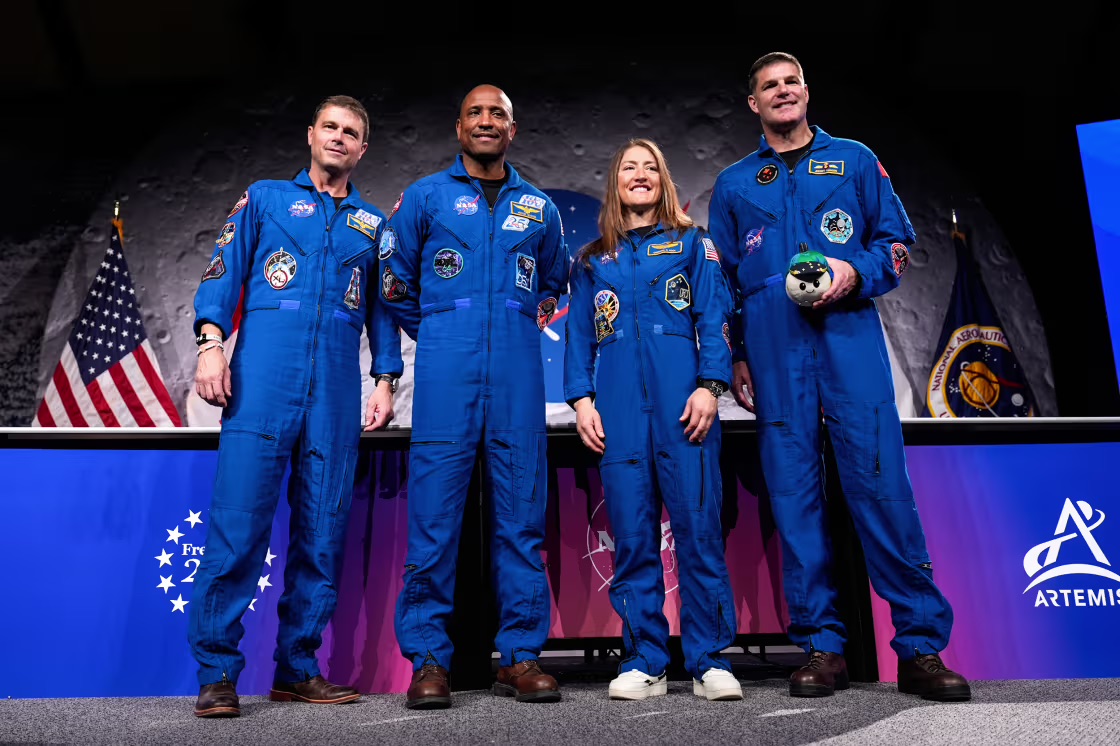
The Orion spacecraft Integrity splashed down in the Pacific Ocean at 8:07 a.m. on April 10, marking the end of the Artemis II mission. On the 10-day trip, four astronauts traveled farther than any other humans have in history, viewing parts of the moon that have never been seen before. While the data collected from the mission is still being analyzed, the images alone have provided a large data point, according to URI Physics Professor Rob Coyne.
“I have not dug deep into the publicly released data from the Artemis mission quite yet,” Coyne said. “I have of course enjoyed the images. Those images, although many of them are simple, just awe inspiring and pretty, they’re also doing really important work as scientific data.”
Coyne is researching gravitational wave astrophysics, with concentrations in multi-messenger astronomy and Gamma-Ray burst astrophysics. The other astrophysics research group at URI, The Quasar Group, makes multiwavelength images of quasars, extremely active and luminous galactic nuclei.
It is hard to say what the Artemis II data can truly do for scientists at this point, according to URI Physics Professor Jaewoong Jung. Artemis II, a precursor mission for the future Artemis missions, will provide the data needed to ensure success in the future. While the data will not have a direct impact on day-to-day work, certain parts of the data will be useful going forward
Lunar exploration might have a large impact on the field of gravitational waves, according to Coyne. Gravitational wave detectors, which are used to learn about black holes and neutron stars, face certain limitations being built on earth.
“They’re incredibly subject to seismic activity,” Coyne said. “The simple active car driving down the road near these devices can impact the data. … I could see the Artemis data being incredibly valuable in helping determine questions like site location and environmental stability.”
Influencing research in the field of space physics, which studies the sun’s impact on the near-Earth environment, a device named AVATAR was present on Artemis II. The device measures the impact of radiation on human tissues. The data from the mission will provide great advances in keeping astronauts safe, according to Jung.
“How radiation affects humans is an important topic in space physics,” Jung said. “Artemis II data is a valuable data point.”
In space physics, the next big step is the launch of the Solar Wind Magnetosphere Ionosphere Link Explorer, which has X-ray and ultraviolet imagers to observe the interaction between the sun and the near-earth environment, according to Jung.
For lunar exploration, Artemis III and IV are in the works. Artemis III will look to test the interface systems that will be required in long-term lunar exploration, such as lunar landing gear. Artemis IV will be sending humans back to the moon.