
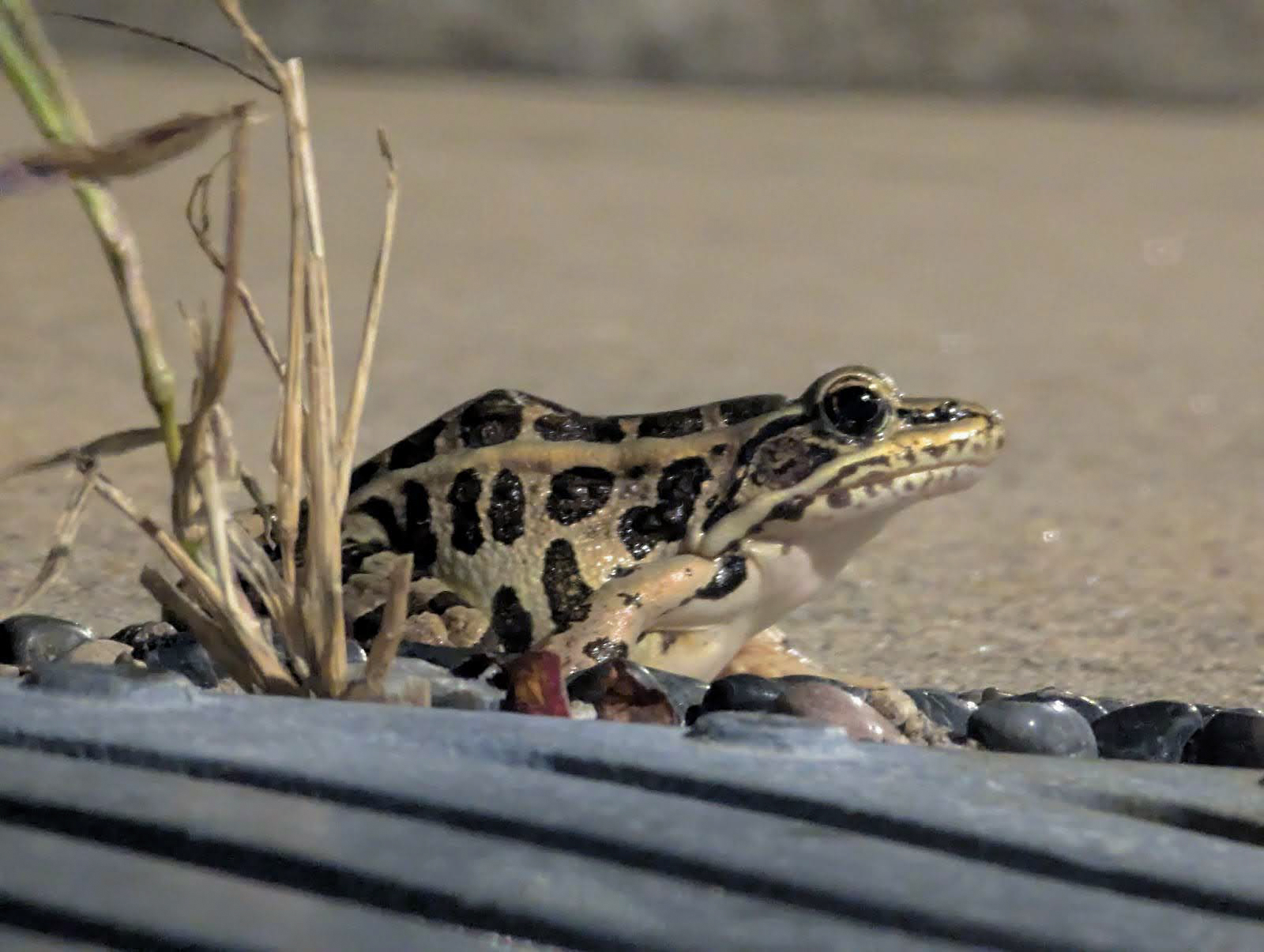
Lithobates palustris–the pickerel frog– is a medium-sized frog and the only native poisonous frog in North America.
These amphibians secrete toxic bradykinin compounds through their skin. As you can imagine, this defense is capable of deterring many predators. Given the choice between a poison sandwich and a poisonless sandwich, I’m siding with the latter every time.
Unfortunately for pickerel frogs, this defense isn’t bulletproof. These frogs do have many predators, such as larger frogs, birds and snakes. Evolution can be an arms race. Sometimes, spite runs so deep that predators will evolve a tolerance to poison, which makes me curious if one day generations after me will be able to scarf down a couple of poison sandwiches without a care.
Pickerel frogs get their name from the pickerel, the smaller representatives of the Esox genus and iconic freshwater fish in the Northeast United States. Pickerels are lanky ambush predators, the smaller cousins of Pike.
Pickerel fish and pickerel frogs share only passing similarities. Pickerel frogs are semi-aquatic, and pickerel fish are fully aquatic. Pickerel frogs are insectivores. Pickerel fish are apex piscivores. Pickerel frogs are capable of hip-hopping. Pickerel fish are capable of fish-flopping.
The list of differences can go on and on, but the connecting feature of the two animals is their similar patterns, which is also the most striking feature of the frogs, an important feature for identification.
Pickerel frogs are most active in Rhode Island from April to October, which means they will be out and about soon. Pictured above is a frog found last October, right outside the Center of Biotechnology and Life Sciences. If you are interested in finding the only native poisonous frog in North America, I recommend visiting the North Woods or any high-cover body of freshwater. Be sure to keep a safe distance and use a keen eye.
You’ll likely spot them after a hop, a grand blur of movement that announces both presence and prowess. If only we could jump that proportionally high. Forget about walkable city infrastructure, imagine building around hoppable city infrastructure.
Frogs and amphibians as a whole are some of the world’s most important pioneers. They are descendants of the first fish-like organisms that decided that the whole “land thing” was worth a shot, and thus all of us terrestrial vertebrates have them to thank.
It probably is crazy to be a frog. To undergo such a metamorphosis. To start as a fish in all but name. To progress to limb growth and then finally a hop out into the unknown. Sure, we all grow and change, but to grow from one niche to another, from aqueous to aerial, must be something.
I wonder if frogs experience nostalgia differently from us. As we get older, we miss the sights and sounds of childhood. With such a great change, do frogs miss the feeling of aquatic respiration? Do they yearn to swim again? Maybe life in the water is too dangerous for a tadpole to miss it. After all, there is always a bigger fish.
Whatever the case may be, we must protect the entire class of Amphibia. These remarkable critters are particularly susceptible to anthropogenic pressure and have seen sharp declines in many areas. Do not forget frogs, cherish what you have, and keep in your arms what you want to protect.