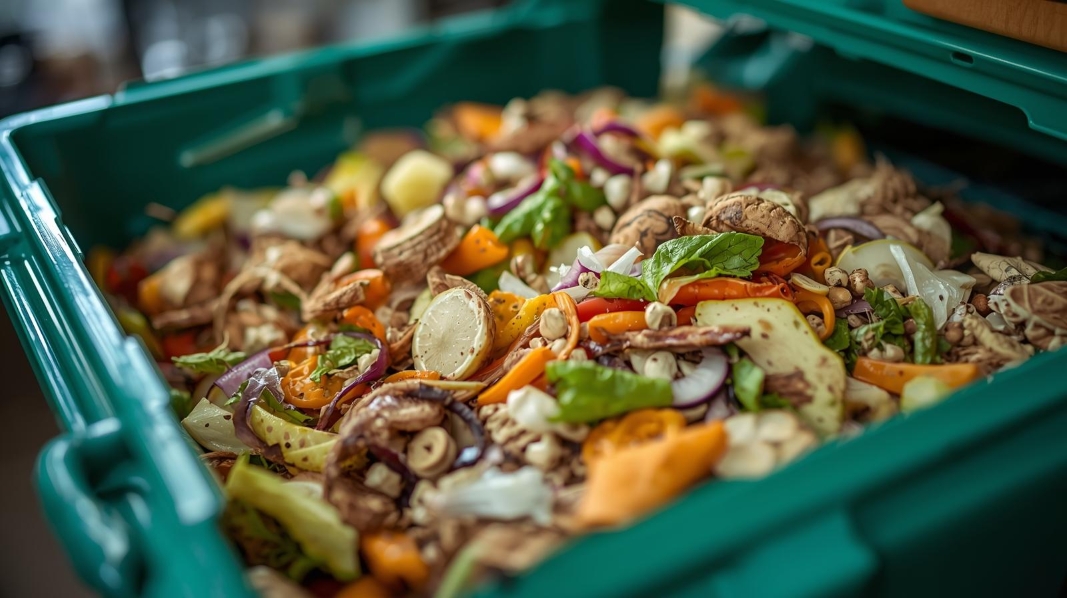
Newport Rep. Lauren Carson introduced the “Organics Diversion at Catered Events Act” in a bill on Feb. 12, requiring caterers to be responsible for creating food waste diversion plans, despite infrastructure challenging its feasibility.
The bill, which further enforces the 2021 Rhode Island food waste ban, would require caterers to arrange their own composting or food waste haulers and then submit their plans to the Rhode Island Department of Environmental Management for approval, according to an ecoRI article. Failure to comply with their plans can result in fines of up to $500 for the catering companies.
The feasibility of RIDEM supporting and enforcing RI H7735 is rocky due to funding and logistics, according to Dylan Murdock, program coordinator for the University of Rhode Island Dining Services’ Food Waste Diversion Program.
“It’s that infrastructure that’s the main issue,” Murdock said. “Current timelines: we’re half a decade to a decade to get this up and running.”
Since the caterers are responsible for coming up with their diversion plans, guidance from RIDEM on necessary or recommended components would be limited, according to Murdock.
“Without any sort of structure coming from RIDEM on how to do this process, it’s sort of going to be wild wild west in terms of what people are going to be doing [or] not doing within the process,” Murdock said.
The greatest form of support for funding would be from the federal government, an actor that is unlikely to help under the Trump administration, according to Murdock.
“We are not going to see any federal support for a push like this that really would be something just hopeful to see,” Murdock said. “It’s not going to happen in the short term.”
URI Dining and Catering Services already have food waste diversion plans in place with pre- and post-consumer recycling and composting according to Murdock, who spearheaded the post-consumer effort in the 2024-2025 academic year.
“If you were a large enough producer of food waste, you had to distribute it to either a distribution center or a composting center, and that’s where the backend partnership with the URI Dining Services happened,” Murdock said. “It was through that process that we were able to find that opportunity to divert that front-end food waste.”
Despite the lack of infrastructure, the bill is necessary, according to Murdock. While Rhode Island is known as a blue economy hub, it can transition to a more green one as well.
“The constant reliance on fossil fuels as the main driving force of economics is not sustainable long term,” Murdock said. “Any continuing development of systems and industries that reduce our reliance upon oil and gas is always good.”
At the university level, catering services’ operations are unlikely to change since they are already following the 2021 legislature with diversion plans in place, according to Murdock. The Food Waste Diversion Program will simultaneously begin its leadership transition as it moves into the 2026-2027 academic year.
“I have to continue to build and lead things that live longer, live past me, live past my time here at URI, because that’s how we make real change,” Murdock said.
Positions are available on Handshake to apply for the program.