
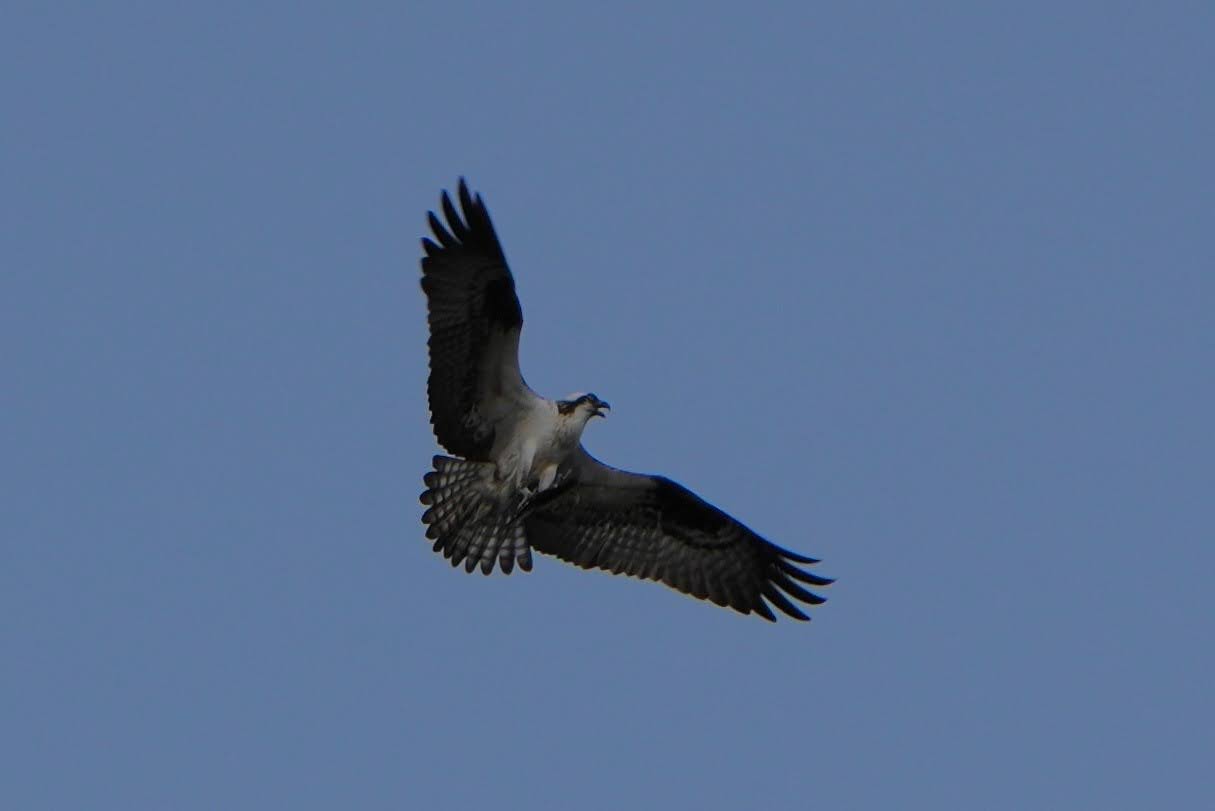
Pandion haliaetus–the osprey–is a large bird of prey with a worldwide distribution.
These notorious piscivores are experts at catching fish, hovering up to 40 meters above the water before locking eyes and locking in, plunging into the brine. It is estimated that about 99% of an osprey’s diet is fish, which puts even the most dedicated chowder enthusiast to shame.
These birds of prey have gone by many names, including “fish hawk”, “river hawk”, and the mascot of 2026’s very own Super Bowl champions, the “sea hawk”.
Growing up, this was a favorite of mine. The Jersey Shore is speckled with artificial osprey nests with these charismatic critters. They get a lot of attention and love from the older naturalist and marine scientist crowd in the state. In my early years, I was acutely aware of the Seattle Seahawks, with their couple of Super Bowl appearances of varying quality. Despite this, it took me years to figure out the connection.
Here’s the thing, guys. An osprey looks nothing like a hawk, whatsoever. It has a wicked beak and a classic rebellious ’80s-do, creating a party in the back.
Evolution backs this up; the osprey and its subspecies are alone in their own family and by extension, genus. They differentiated from the major birds of prey over 50 million years ago! These guys have been kicking it their own way for a while and are specially adapted to their aquatic diet.
Although this species is common now, there was a time in the 50s and 60s where the situation was dire. Back in the day, DDT–or as the cool kids know it, Dichlorodiphenyltrichloroethane–was the go-to miracle chemical for all of your insecticide needs.
The problem was that DDT was wreaking havoc on the population of predatory birds, especially the osprey. DDT would be released into the environment and wind up in waterways, where it would be absorbed by early food chain organisms. From here, a fascinating and frankly terrifying process of biomagnification would occur, where each step in the food chain would increase the concentration of DDT.
Let’s break this down a little. If I am five grams and have one gram of DDT in me, and then 70 other friends and I get consumed by an 80-gram predator, you are greatly increasing the concentration.
Unfortunately for the osprey, they are around two to five rungs up that ladder as a keystone and apex predator at the top of the food chain. They got loads of DDT in their system via biomagnification, which severely limited the fitness of their eggs, causing their population to crater.
In a triumph of restoration ecology and chemical analysis, the toxin was identified. The proper policies were put into place to keep these guys kicking to this day, now with a global population estimated to be exceeding 450,000 individuals.
In the early 1970s, many countries began to ban DDT and introduce artificial nests, which worked like a charm; a great reminder that nature can heal when science and policy sing the same song.
In these artificial nests, you may be lucky enough to find a mated pair. Osprey mate for life, which is especially impressive considering how far some individuals migrate.
With a keen eye and a little luck, you may be able to see an osprey perched in a wooded area flying high above the main campus. You are much more likely to find them at the Bay Campus, where this picture was snapped.
If you do see one at the Bay Campus, be sure to observe its keen fishing ability. It is impressive the size of the fish they target and catch.