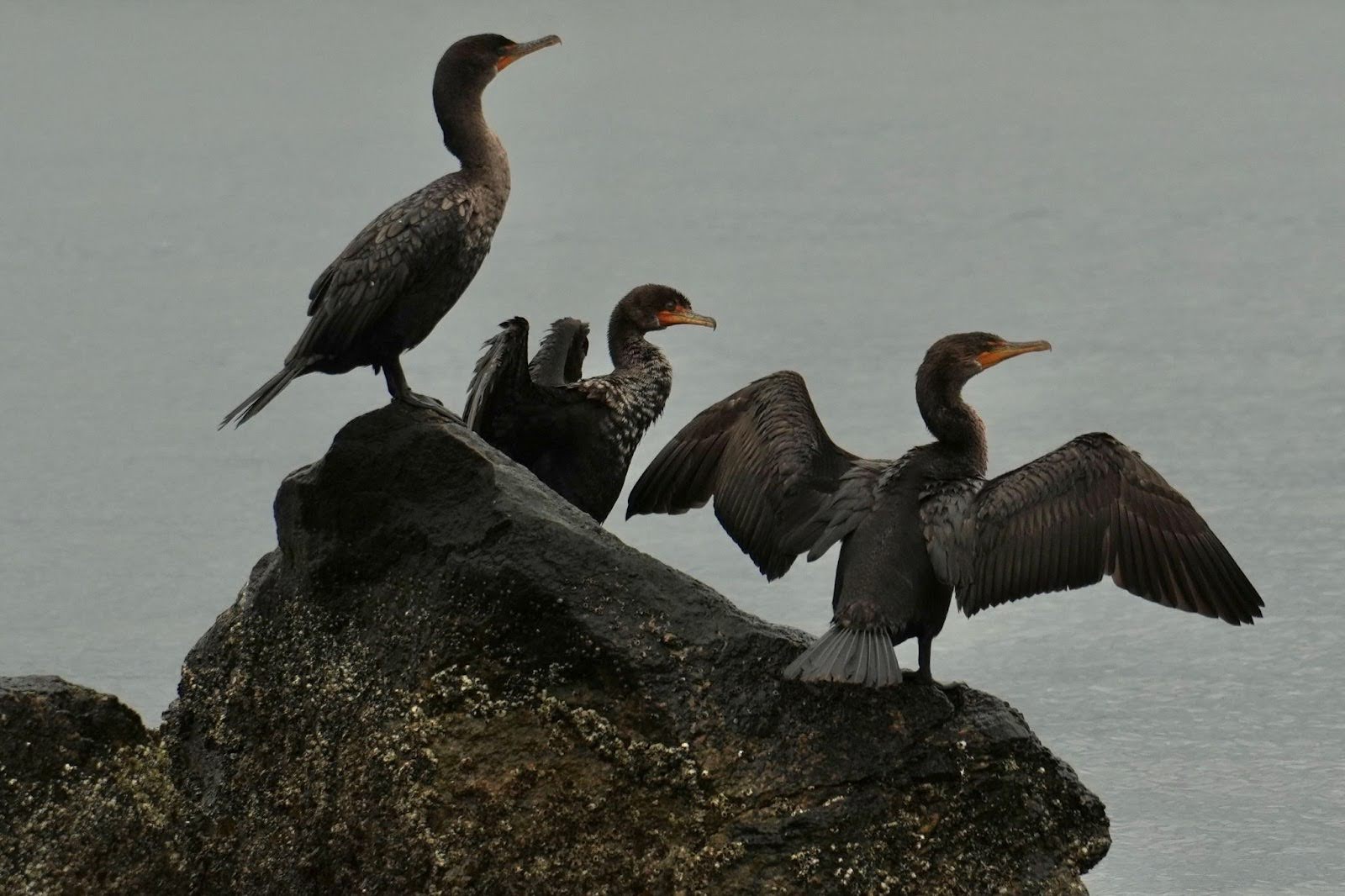
Nannopterum auritum – the double-crested cormorant – is an aquatic bird native to nearly all parts of North America and can be found year-round in Rhode Island.
Although rarely seen on the Kingston Campus (but certainly not unheard of), they remain an ever-present fixture at the Narragansett Bay Campus; home to the Graduate School of Oceanography. These critters are more than capable of terrestrial life and often trek through the heart of the continent for migration. However, most cormorants make an understandable value judgment of sticking to the unmatched tranquility and majesty of the sea. I promise I am not biased…
Regardless of any hypothetical authorial nautical preferences, there are plenty of reasons why cormorants prefer the water. They are efficient swimmers and even better predators. If you have the opportunity to visit the Narragansett Bay waterfront, which includes URI’s very own Bay Campus, I encourage you to observe the cormorants’ impressive swimming ability.
Few mariners actually take the time to see the double-crested cormorants for what they are. Sometimes your success will cause judgment. Some call it jealousy, but I take a more ecological approach. When someone takes your niche, you better fight like hell to survive and outcompete.
With their ability to catch fish and take over the area, they are considered a nuisance species by fishermen across the world. How could you blame either party? Both need to make a living after all. Both need fish.
Beyond their fish-catching abilities, cormorants are also considered a nuisance due to their highly corrosive acidic guano, or, for the less ornithologically inclined among you, waste. This aspect of their ecology isn’t necessarily the subject of envy, or at least I really hope it isn’t.
Despite a potential framing of conflict through the lens of ecology, the field also gives us insights into how stable coexistence is possible. The equations and models described by academics and graphing pioneers, Alfred J. Lotka and Vito Volterra, give us a guide on how two competitors can coexist. It happens all the time. However, this peace is fragile.
When you venture beyond the fear of the unknown, into an environment we are not necessarily meant to be in, we can explore the wonders of the deep. Buoyancy, a concept rarely experienced terrestrially, becomes physiologically feasible. You are given access to free movement in three dimensions.
Exploring this ecosystem, while suspended in the midst of its medium, allows you to appreciate the purpose of it all. Cormorants understand this privilege. Cormorants are able to appreciate land, sea and air – a trifecta of motility rare in the animal kingdom.
Don’t you wish you had that freedom? To have the laws of nature hang just a little less heavily on your shoulders? To see the environment not as a barrier but as an opportunity for boundless adventure? I wish you did. You would probably love it.
Although I can’t grant you the physiological traits to grant you the freedom you deserve, you can appreciate it next time you visit the Bay Campus. You’ll surely spot some cormorants resting on the rocks and buoys, swimming without a care for limitations in hydrodynamics.
For the human regulars of the Bay Campus, such as this column’s photographer and I, a break from lab work, when experiments and data are processing, often means a quick jaunt to appreciate the shoreline of the campus. When your place of work has a beach, you have to take advantage of that. When in Rome, y’know. With our futures uncertain and yet to be written, it’s important to remember why you want to be anything at all. It’s important to find your beach to wander at.
I encourage you to try to find this wonder for yourself. Maybe it can come from a double-crested cormorant. If you can find purpose and peace in a nuisance, just imagine what else the natural world can tell you.