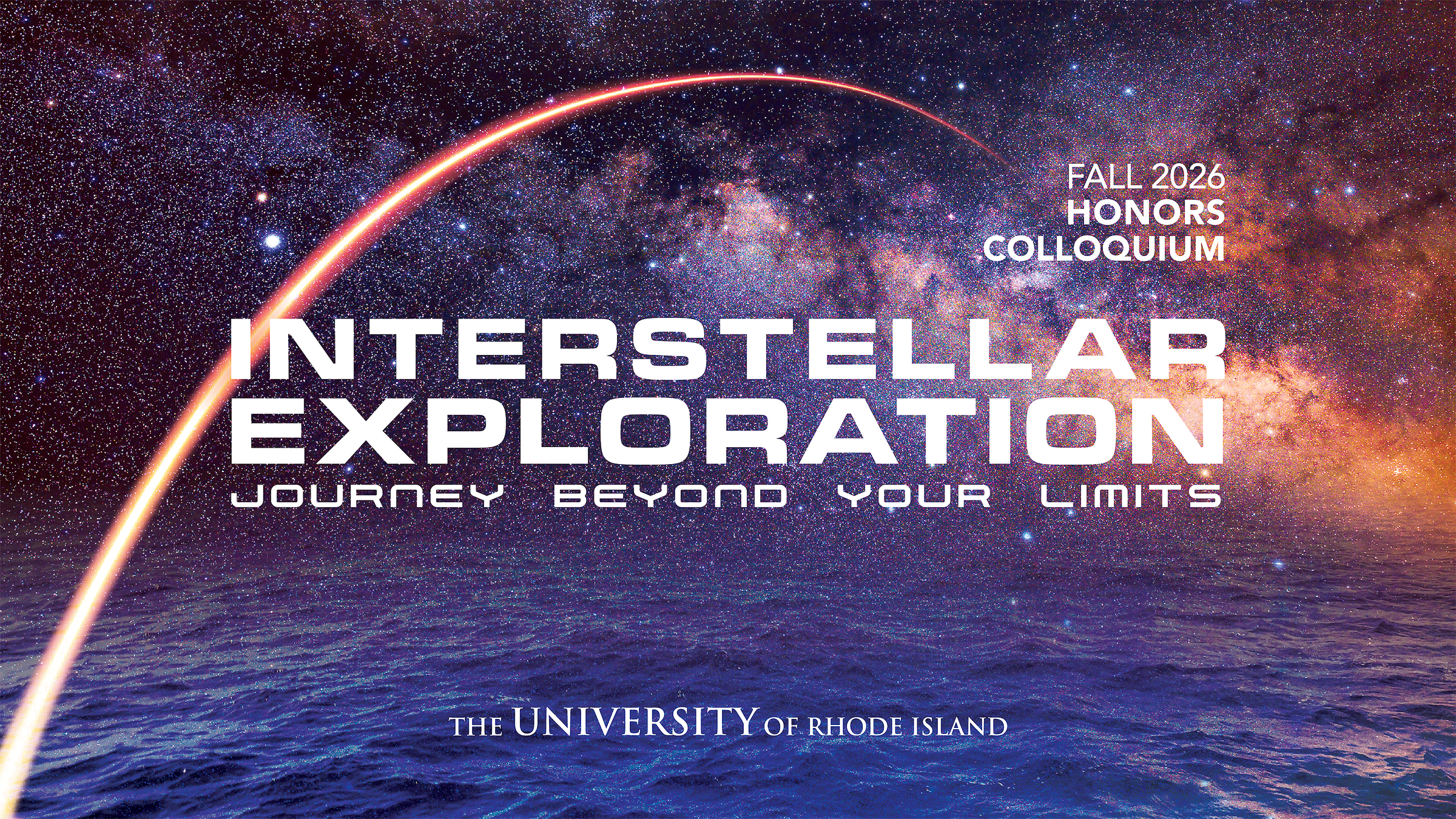
The University of Rhode Island’s Honors Colloquium opened its fall series Tuesday with physicist and author Les Johnson, discussing whether humans could one day travel beyond our solar system and what it would take to get there.
For Marie Pinsky, a URI first-year student who attended the lecture, the discussion made the possibility of space travel feel more realistic.
“I always wondered if going to other planets was actually possible for humans, so it was cool hearing a physicist confirm that it could be,” Pinsky said. “Even though he said it probably won’t be possible for a really long time, it was still interesting to think about.”
The first speaker of the series, physicist and author Les Johnson, introduced students to the scientific possibilities and challenges of interstellar exploration. As the lights dimmed in the auditorium, images of stars, planets and distant galaxies appeared on the screen, creating a visual introduction to a subject that often feels limited to science fiction.
Johnson connected those familiar fictional ideas to real scientific research, explaining that although traveling to another star is not yet possible, scientists continue to study the technology and conditions that could make it possible in the future.
Johnson emphasized the enormous distances between stars and the difficulty of developing propulsion systems capable of carrying humans across them. The presentation also addressed the amount of time, energy and technological advancement that would be required for interstellar travel.
Rather than presenting space exploration as an immediate possibility, Johnson focused on the questions scientists must answer before humans could safely travel beyond our solar
system.
The lecture also introduced the larger purpose behind this year’s Honors Colloquium, which will examine interstellar exploration from scientific, ethical and social perspectives. Leonard Kahn, one of the coordinators of the series, said the popularity of Project Hail Mary and the Artemis II Launch renewed public interest in actual space exploration helped inspire the theme.
Kahn said that the desire to explore the unknown is a fundamental part of human nature.
“I think that the quest to explore the unknown has always been part of our DNA,” Kahn said. “The more we learn about the universe, the more we learn about ourselves.”
He said the colloquium gives the university community an opportunity to learn about the potential benefits and challenges of exploring beyond Earth.
Kahn said he hopes students leave the series with a better understanding of the vastness of space, the technological hurdles involved in reaching it and the excitement that comes with overcoming
difficult scientific challenges. He also emphasized that interstellar exploration is not limited to physicists or engineers. Students from across the university can contribute to conversations about space through science, ethics, environmental studies, sociology and other fields.
The series will explore questions that extend beyond whether humans can build a spacecraft capable of reaching another star. Future speakers will discuss the ethical, sociological, environmental and financial effects of space exploration, including who benefits from new discoveries and how humanity should approach the responsibility of expanding beyond Earth.
These questions place interstellar exploration within a broader conversation about the future of humanity and the choices that could shape generations to come.
As the Honors Colloquium continues throughout the semester, students will have the opportunity to examine not only how humanity might reach the stars, but also why we might choose to do so and what responsibilities would come with that achievement.