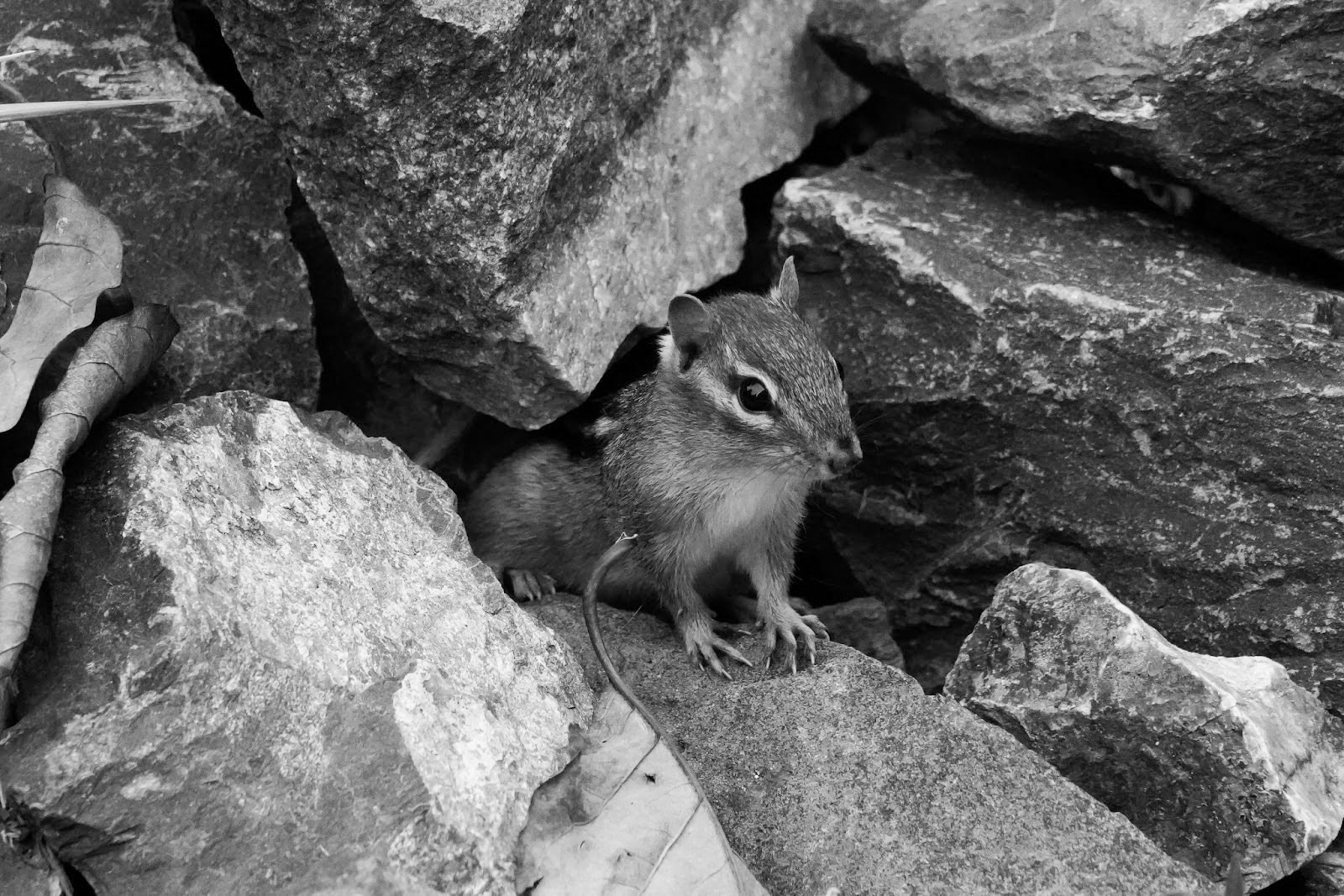
Tamis striatus — the eastern chipmunk – is a tiny rodent found in the eastern half of the North American continent and in magical corners all around campus at the University of Rhode Island.
These resourceful omnivores are known for their intricate underground burrow systems, where they hide and store food. Chipmunks live in their burrows alone, only interacting with others during mating season.
Chipmunks are masters of finding and reaching cover. They take comfort everywhere from brushes, rock piles and tree falls when the safety of their own burrow cannot be accessed.
Chipmunks are closely related to the iconic grey squirrels on campus, with all chipmunks and squirrels belonging to the taxonomic family of Scircadae. If you look close enough and for long enough, you’ll see the undeniable close resemblance between the evolutionary cousins.
Despite their ecological solitude, chipmunks have an amazing PR team that allows them to get high-ticket roles in blockbuster movies and series. From the titular Alvin and his posse of slightly more bearable but undeniably less interesting chipmunks to the seemingly antithetical and deeply paradoxical Chip & Dale, chipmunks have left their mark in media history. Despite squirrels being significantly more common, not to mention morphologically and taxonomically adjacent, they just don’t hit the big leagues like the chipmunk. Without Sandy Cheeks, it’s slim pickings for the chipmunk’s sciuridae brethren in media.
Don’t let the media fool you. Clearly, there is a big disconnect between what you see in the forest versus what you see on television. Something is clearly wrong. I mean, c’mon, have you heard a chipmunk sing, let alone show the media savviness to kickstart the highly exalted genre of nightcore? In your dreams, Ian Hawke. In your sick little dreams.
Maybe there is a deeper reason why we have gravitated toward chipmunks. They are quite cute after all. But I am not satisfied with this simple explanation. Cuteness can not solve a paradox. I think chipmunks are tired of being defined by reality. The constructs of an ecosystem don’t allow them to express themselves.
As soon as they were given an outlet, as soon as large-scale animation hit the waves, the humble chipmunk scurried to the big screen. Perhaps we saw the potential that nature failed to realize. The constraints of natural selection are harsh. The world is harsh. That is why the chipmunk burrows. But in those burrows, when no one else is near, do they dream of a fairer world? Do they sing?
Even if we are giving chipmunks too much credit, the mere allowance for us to speculate has given us the ability to reimagine an entire family of species into something greater than itself. Maybe we wanted them to go on adventures and sing the same pop songs we sing. We chose to personify this animal. We saw ourselves in it.
Maybe we are capable of justice. In the whimsical, we can find reconciliation. We can make this world a better, if not more absurd, place. We just have to work together and let the art speak for itself.